
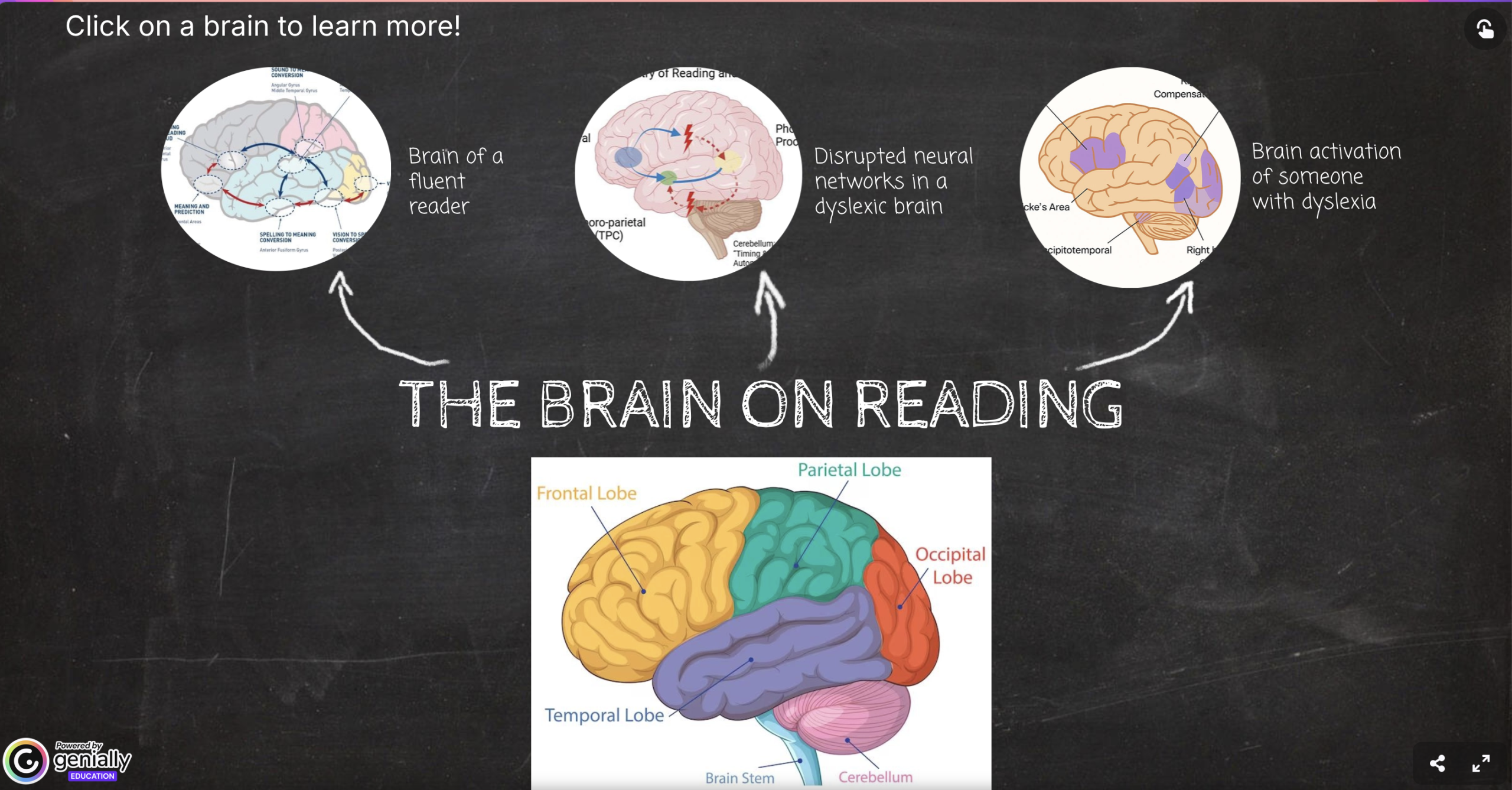
Reading may feel automatic to a skilled reader, but it is actually a complex process that requires several areas of the brain to work together. The brain must recognize printed letters and words, connect letters with sounds, access language and vocabulary, and construct meaning from the text.
For individuals with dyslexia, these reading networks may develop and function differently. This does not mean that a person with dyslexia is less intelligent or incapable of becoming a successful reader. It means that reading may require more effort, more time, and carefully designed instruction.
The interactive presentation below explores how dyslexia affects the brain, the neural pathways involved in reading, and some of the differences researchers have observed between typical readers and readers with dyslexia.
Explore the Brain’s Reading Network
Click through the interactive presentation to learn about the areas and pathways involved in reading. Select each brain image to explore how proficient reading develops, where disruptions may occur, and how readers with dyslexia may rely on different patterns of brain activation.
Dyslexia Reflects a Difference in Brain Organization
Brain-imaging research has shown differences in the neural systems used by typical readers and readers with dyslexia. These differences often involve networks in the left side of the brain that support phonological processing, word recognition, and the connection between written letters and spoken sounds.
When these processes are not efficient, a reader may have difficulty:
- Identifying and manipulating the sounds in spoken words
- Connecting letters and letter combinations with sounds
- Reading unfamiliar words accurately
- Recognizing familiar words automatically
- Reading fluently while maintaining comprehension
- Spelling words accurately
A student with dyslexia may compensate by using context, meaning, memory, or other available information to identify words. This can sometimes look like guessing. However, it often reflects the student’s attempt to complete a demanding reading task using the strategies and neural pathways available to them.
The Brain Can Change With Effective Instruction
The encouraging news is that the brain is capable of change. This ability is known as neuroplasticity. Research on reading intervention has found that effective instruction can support changes in reading performance and patterns of brain activity.
Students with dyslexia benefit from instruction that is explicit, systematic, cumulative, and responsive to their individual needs. This includes direct teaching in:
- Phonological and phonemic awareness
- Sound-symbol relationships
- Decoding and word recognition
- Spelling patterns
- Morphology and word structure
- Reading fluency
- Vocabulary and comprehension
With appropriate instruction, practice, and support, individuals with dyslexia can strengthen their reading skills and become confident, successful readers.
Dyslexia Is Not a Lack of Effort
Understanding the reading brain helps explain why encouragement alone is not enough to resolve a reading difficulty. A student with dyslexia may be working extremely hard, even when progress is slower than expected.
Early identification and evidence-based intervention can help students build foundational skills before frustration and academic demands increase. Support should recognize both the student’s reading needs and their individual strengths.
Concerned About Your Child’s Reading Development?
If your child has persistent difficulty with decoding, spelling, reading fluency, or phonological awareness, a comprehensive evaluation can help identify their strengths and determine what support may be appropriate.
The Reading & Language Learning Center provides individualized evaluation and therapy services for children and adolescents with dyslexia and other language-based learning differences.
Contact us to learn more about our reading and language services or to discuss your child’s needs.
FAQ Section
Is dyslexia caused by a vision problem?
Dyslexia is primarily a language-based learning difference, not a problem with eyesight. Although reading begins with visual input, the central difficulty commonly involves processing speech sounds and efficiently connecting those sounds with written language.
Do people with dyslexia use different parts of the brain when reading?
Brain-imaging studies have found differences in the activation and coordination of reading-related networks in people with dyslexia. These patterns vary among individuals and can also change with development and effective intervention.
Can reading intervention change the brain?
Research provides evidence of neuroplasticity following reading intervention. Effective instruction can support improvements in reading and changes in how reading-related brain networks function.
Can a child with dyslexia become a successful reader?
Yes. Dyslexia is lifelong, but individuals with dyslexia can significantly strengthen their reading skills with appropriate, evidence-based instruction and accommodations.